Apple’s recent manufacturing investment strategy is reshaping its influence on the tech landscape, driving significant changes in the job market and investor decisions alike. Understanding this investment and its implications could change how consumers perceive and interact with the brand.
What is Apple manufacturing investment and why does it matter?
Apple has unveiled a robust commitment to invest over $600 billion in manufacturing over the coming years. This significant figure isn’t just a number—it’s a reflection of the company’s strategic response to both competitive pressures and evolving market demands. For investors, this development could have a direct impact on stock performance, while consumers may find themselves at the forefront of innovative products stemming from these investments. You can check out the detailed announcement on Apple’s commitment here.
With such substantial financial allocations, understanding the breakdown of this investment will be crucial. Areas like technological innovation, final assembly locations, and anticipated production volumes can dramatically influence job creation and economic growth. Furthermore, exploring how these changes will affect tariffs and production costs can give a clearer picture of the potential impacts. For those interested in the intersection of technology and finance, insights into these manufacturing decisions are increasingly vital. If you’re curious about optimizing investments in tech companies, visit this guide on investing in OpenAI for related concepts.
How does Apple manufacturing investment influence the job market?
As Apple expands its manufacturing footprint, the implications for employment are profound. These investments signal not only job creation but also a shift in skills demand across various sectors. To understand what this means for American industry, construction, and supply chains, check out this analysis on the job impact. This exploration will show how Apple’s decisions could redefine local economies and employment landscapes.
What are the financial allocations for apple manufacturing investment?
Apple’s 2025 promise is a $600 billion U.S. spend through 2028.
The headline looks huge, but the split tells the real story:
| Category | Share of total | What it covers |
|---|---|---|
| Domestic silicon & advanced chips | $65 B | New Arizona/Texas foundries |
| Final assembly plants | $48 B | Houston, Mesa AZ, and two un-named states |
| Supplier tooling & automation | $42 B | Robot lines, CNC cells, test rigs |
| Data-center servers for U.S. cloud | $25 B | Reno, NC, and Iowa expansions |
| Logistics & green power | $20 B | Solar farms, battery storage, rail spurs |
The rest—about $400 B—is the everyday flow: U.S. payroll, retail, R&D, and the parts Apple was already buying from Broadcom, Micron, and Corning. In short, only the first $200 B is “new metal in the dirt.” That detail matters if you’re tracking how much of the apple manufacturing investment actually turns into factory jobs instead of office work.
Source figures are updated from CT Mag’s breakdown.
Key industries affected
1. Semiconductors – Apple is now a co-investor in two Arizona fabs that will build the “Made in USA” stamp on future iPhone chips.
2. Precision machining – 900+ small shops in the Great Lakes region have received orders for 5-axis mill-turn centers.
3. Battery pack assembly – Tesla lost Apple as a Reno tenant; Apple kept the building and is turning out stationary storage packs for its data halls.
4. Automation software – Every new line needs vision systems and edge AI, pumping cash into start-ups like Landing AI and Arcure.
Investors should still weigh what happens if demand slips. A quick way to size that risk is our plain-language guide on investment risk management.
Comparison of U.S. vs international production
Today, 80 % of iPhone final assembly sits in China and 12 % in India. The new plan flips the mix to roughly 60 % China, 20 % India, 20 % U.S. by 2028.
Tariffs are the hidden driver. A 10 % duty on Chinese phones equals about $48 per unit—enough to erase Apple’s entire iPhone gross-margin cushion. U.S.-built units avoid that hit, but only if 35 % of the component value is domestic. Apple’s fabs in Arizona and the new Houston motherboard plant push the math just past that line.
Houston’s case study shows the stakes. The city landed the deal by offering:
-
- A 20-year property-tax discount worth $185 m
-
- A ready workforce—47 % of local community-college grads hold tech certificates
-
- A port within 90 minutes for heavy machinery imports
More context in this Houston benchmark report.
What are the projected outcomes of apple manufacturing investment?
-
- Production: 30 M additional “U.S.–assembled” iPhones per year by 2028
- Jobs: 83 k direct supplier jobs and 125 k indirect jobs (construction, food, transport)
- Wage premium: Average $31/hour—$9 above the current Texas manufacturing mean
- Carbon: Apple claims a 25 % drop in shipping emissions for North American orders
Case study on the Houston facility
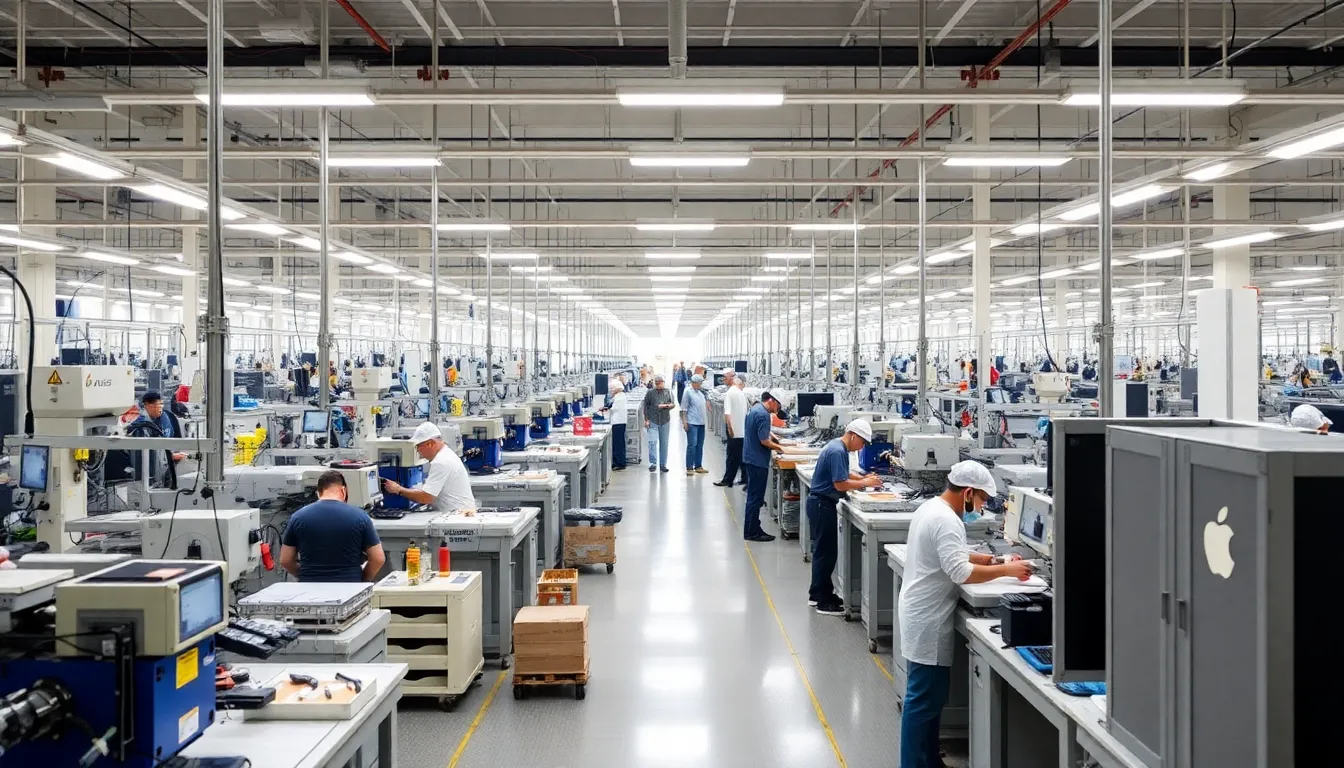
Apple bought a 1.2 M-square-foot former HP campus in northeast Houston. Retrofit started March 2025; first line fires up January 2026. The plant will:
-
- Build logic boards and laser-weld them into the stainless-steel iPhone frame
-
- Employ 7 000 people in three shifts
- Pay zero Texas state power fees for ten years in exchange for on-site solar that feeds the grid at midday.
City economists predict a $2.3 B yearly bump to local GDP once full output is reached. Apple’s own newsroom release confirms the location and scale—see the August 2025 update for the official numbers.

Why is Apple Manufacturing Investment Pivotal for Future Growth?
Investing in Apple manufacturing is crucial not just for the company, but for the broader economic landscape as well. This strategy signals a strong commitment to domestic production, which in turn can create thousands of jobs and spur local economies. By pouring resources into manufacturing, Apple is setting the stage for future innovations and sustainable growth. The ripple effects of this investment can elevate the job market, improve wages, and encourage a more robust supply chain, benefiting various sectors.
As Apple aims to enhance its manufacturing base, there’s a wealth of opportunities for investors who align with these growth strategies. If you’re eager to learn more about potentially enriching your portfolio through smart investment practices, consider exploring our wealth growth resources. For deeper insights on aligning your investment with sustainable trends, don’t hesitate to check out this link.
FAQ for Apple Manufacturing Investment
What are the main benefits of Apple’s manufacturing investment?
Apple’s manufacturing investment comes with a bouquet of benefits. First, it creates numerous jobs, boosting the local economy. Second, a strong manufacturing presence can lead to improved product quality and innovation. Lastly, by focusing on local production, Apple is optimizing its supply chain, reducing dependence on overseas manufacturers. If you’re curious to dive deeper into the specifics, you can check out this article on Manufacturing Dive.
How will tariffs affect Apple’s investment plans?
Tariffs can have a direct impact on the costs associated with manufacturing and sourcing materials. Depending on the nature and scale of tariffs, they could either inflate production costs or prompt Apple to reevaluate its supply chain dynamics. Understanding these shifts is essential for investors and consumers alike. For a broader view of how these policies might affect Apple’s investments, head over to Apple’s newsroom.
What does the future hold for Apple’s manufacturing strategy?
The future seems promising, as Apple is likely to continue investing heavily in domestic production. This could encompass not only newer technologies but also greater environmental sustainability in manufacturing processes. That’s important for both the planet and investors keeping an eye on socially responsible investments!
How does Apple’s investment in manufacturing affect global supply chains?
By making substantial investments in manufacturing, Apple is setting trends that could influence global supply chains. When a major player commits to domestic production, it encourages other companies to evaluate their supply chain strategies. Thus, this can lead to modernization efforts, better practices, and possibly even collaborative frameworks among tech giants.
What role does innovation play in Apple’s manufacturing investments?
Innovation is at the heart of Apple’s manufacturing strategies. With each investment, there’s a drive to integrate cutting-edge technologies that enhance efficiency and produce high-quality products. This not only keeps Apple ahead of competition but also influences technological advancements across the industry.
By focusing on Apple’s manufacturing investments, it’s clear that the implications stretch far beyond the company itself. As both an economic catalyst and a driver of innovation, these strategic moves promise not just growth for Apple, but a positive shift in the wider economy. The journey ahead appears exciting, filled with opportunities for progress and prosperity.